Before EverJourneys recommends anything, EverCompass finds out what’s actually happening in your business — and what’s getting in the way of where you’re trying to go.
EverJourneys is the company. EverCompass is the framework it uses to diagnose a business and direct what needs to happen next — EverCompass diagnoses and directs; EverJourneys builds and improves what the diagnosis calls for.
EverCompass starts with the problem, not a service.
EverCompass exists so that what gets built is a response to what’s actually constraining your growth — not a guess dressed up as a recommendation.
EverCompass evaluates where a business actually is, then tells you what to do about it.
The result is a clear set of priorities — sometimes one bottleneck, more often a short list in order — telling you what to fix first, what to fix next, and what to leave alone for now. From there, EverJourneys builds and improves the specific pieces that priority list calls for.
How customers discover you, engage with you, decide to buy, and stay — and where that movement is actually breaking down.
EverCompass examines a business across four stages: Attract, Engage, Convert, Retain — and finds out where the constraint actually is, which isn’t always the stage that feels most visible.
These four stages are a lens for locating a problem, not a claim that every growth issue fits into one of them.
Together, they cover most of where a growth constraint tends to show up — positioning, experience, communication, and measurement.
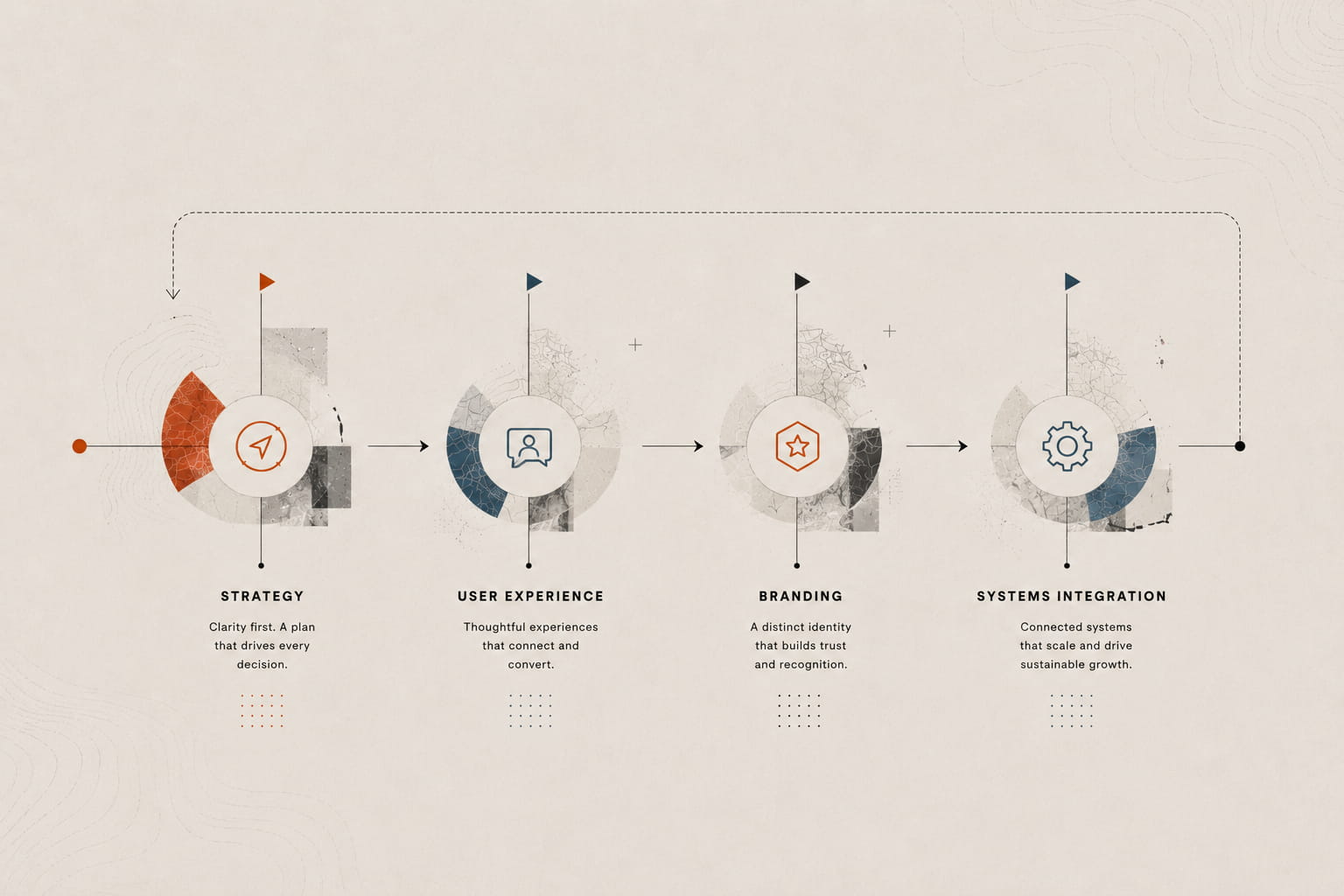
Depending on what the diagnosis finds, the fix might be strategic, experiential, message-driven, or systems-based — often more than one. These aren’t services to choose from. They’re the four capabilities EverCompass has to work with, and it decides which ones a given situation actually needs.
We start by getting clear on what is happening, what is not working, and where momentum may be getting lost.
EverCompass helps us connect the problem to the right part of the customer experience and prioritize the next move.
That might mean strategy, execution, optimization—or a combination of the three.
A better message often can’t hold if the systems behind it can’t deliver on it. A better strategy often can’t move without an experience built to carry it out.
EverCompass treats these capabilities as connected, not separate — because the businesses that get unstuck are usually the ones where strategy, experience, message, and system are solving the same problem together.
Evercompass
The Framework
How we understand the business, diagnose problems, make decisions, and determine what needs to happen next.
Your brand affects trust.
Growth System
The Build
The connected strategy, experiences, content, systems, and improvements we create from those decisions.
The goal isn’t to do everything.
One example of how EverCompass reasons from a stated problem to a specific fix. Every business’s path through this looks different.
A Typical Scenario (illustrative composite, not a real client)
“We need more traffic.”
We start by getting clear on what is happening, what is not working, and where momentum may be getting lost.
The Customer Journey.
We start by getting clear on what is happening, what is not working, and where momentum may be getting lost.
What challenge is universally true?
We start by getting clear on what is happening, what is not working, and where momentum may be getting lost.
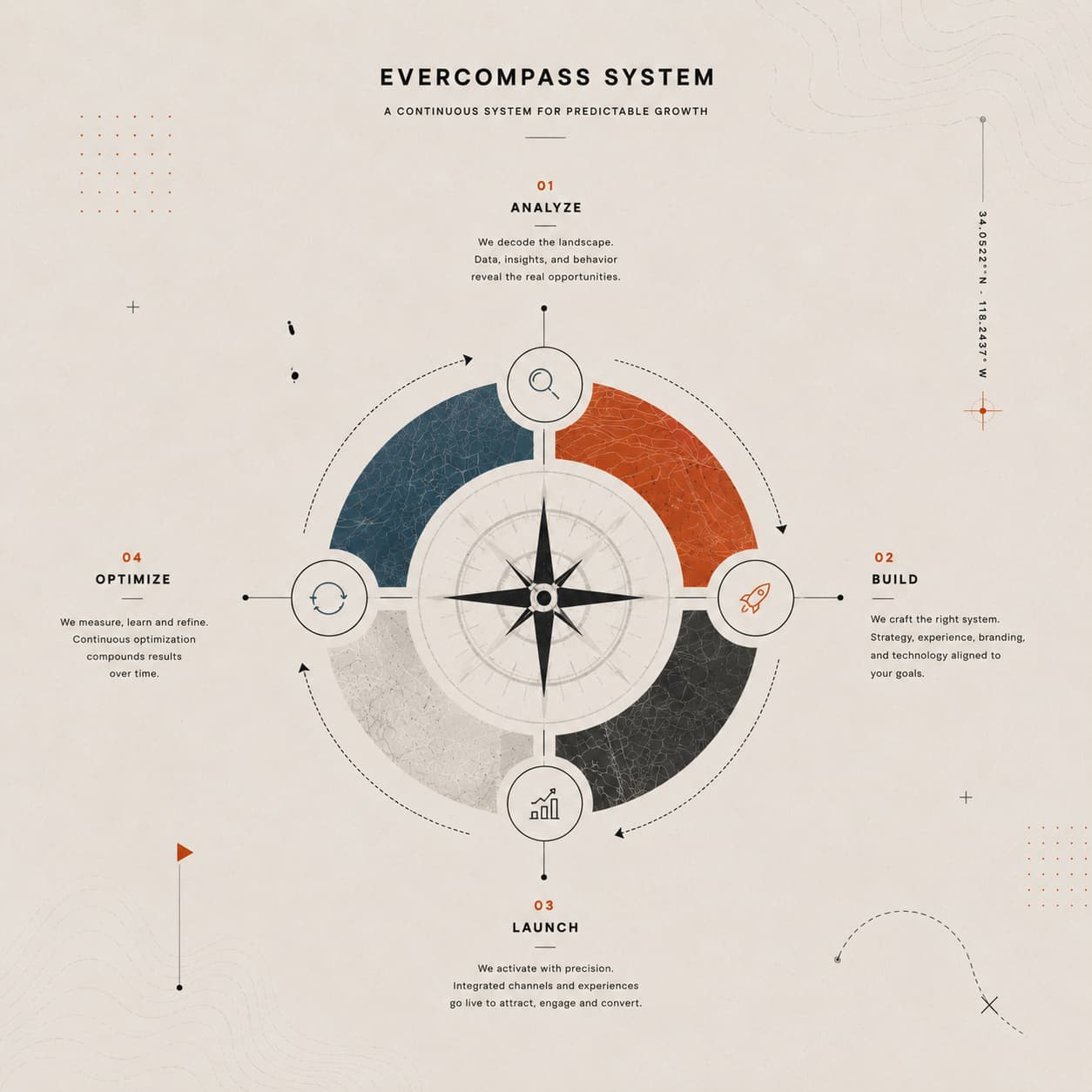
You don't have to start at the beginning. You can enter wherever your business needs the most help. The Customer Journey is where EverCompass looks to find a problem. The Growth Loop is how the fix gets measured and improved — continuously, not once.
Once something is built and launched, EverCompass shifts from diagnosing to measuring: Analyze (look at what the fix actually did, against the problem it was meant to solve) → Build → Launch → Optimize → Repeat. It tracks how the fix performs, decides what that result means, and directs the next move — sharpening the fix or moving on to what’s next in the priority list. Each loop starts from what actually happened, not from zero.
Decisions get made faster, and with more confidence,
because they’re grounded in where your business actually is.
The first step is a Discover conversation — we ask about your business and your customers, not pitch you a service. That conversation doesn’t commit you to anything; deciding how to move forward, if at all, comes after.
Everjourneys - Your Guide to Growth